
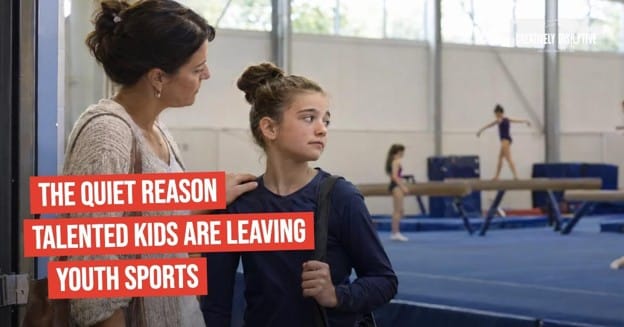
There is a version of this story that plays out in gymnastics clubs and cheer gyms all across the country every single season. A talented kid joins the program. They love it. They thrive. Their coach can see real potential. And then quietly, without drama or complaint, they stop showing up. Not because they fell out of love with the sport. Not because they found something better. Because their family ran out of money.
We recently sat down with a coach and gym owner who spent four decades in competitive youth sports, from athlete to coach to gym owner to industry leader, and she said something that has stayed with us. When kids leave structured sport, she said, they do not just lose gymnastics. They lose the schedule. The structure. The coaches who showed up for them. The teammates who pushed them. The place that felt like a home away from home. And when that structure disappears, she said, a lot of those kids start getting into trouble. Because the gym was the thing keeping them focused, and without it, that focus has nowhere to go.
The rising cost problem nobody is solving for
Competitive youth sports are getting expensive, pricing out families who should not have to choose. A middle-class household earning $100,000 a year might be paying $8,000, $10,000, even $15,000 or more for one child to compete in cheer, gymnastics, or dance when you add up uniforms, competition fees, travel, hotels, and private coaching. After taxes, housing, and everyday expenses, that number can be almost impossible to sustain.
And yet most gym owners treat this as simply the cost of the sport. They do not build a plan around it. They do not think about it at the start of the season. They wait until families start quietly disappearing and then wonder what happened.
Fundraising is not an event. It is a strategy.
Here is the mindset shift that separates the gyms that hold onto their families from the ones that watch them drift away. Fundraising should not be reactive. It should not happen when costs get too high, and families start complaining. It should be built into the annual business plan from day one, planned before the season starts, communicated to families up front so they can see that the gym is genuinely invested in helping them make it work.
The gyms that do this well are not the ones with the biggest budgets. They are the ones where the owner sat down early and asked a different question. Not “how do we get families to pay more” but “how do we help families stay.” That mindset changes everything about how you run your program.
The class business is where most gyms leave money on the table
Here is something that surprises many gym owners when they really sit with it. The recreational class student, the child who just wants to learn a back handspring, who loves their coach, who lights up every time they walk through the door but has zero interest in competition, is almost certainly a bigger part of your revenue than your competitive program. There are far more of those kids than there are competitive athletes. And yet most gyms pour the majority of their energy, their marketing, and their attention into the competitive side.
Meanwhile, those recreational families are underserved, underappreciated, and completely unaware of any pathway the gym has built to help them stay long term. Building systems that support those families, including planned fundraising, pricing that reflects the value you actually deliver, and clear communication about costs from the start, is one of the fastest and most overlooked ways to stabilize and grow a gym.
What struggling gyms consistently get wrong
The gyms that struggle most are almost always the ones where athletes become numbers rather than people. The program runs for the program’s sake. The coach is the personality. The business makes decisions based on convenience rather than what families actually need.
The exceptional gyms are built differently. They teach leadership skills, not just gymnastics skills. They build a culture where coaches and kids have real relationships that outlast any single season. They think about the whole athlete, not just their next competition placement. And they run their business with enough structure and foresight that the families inside it feel supported, not just enrolled. That combination, culture plus systems plus genuine investment in the people in the program, is what builds the kind of gym that families stay in for years and refer their friends to.
What this means for your gym right now
Whether you are two years in or twenty, the most important question is not how many new families you can bring in this month. It is how many of the families already in your program feel genuinely supported. Because a gym that keeps its families is a gym that grows. And the systems that make that happen do not appear by accident. They are built intentionally, from the business plan outward.
If you are a gym owner right now and you are not sure whether your gym has the right systems in place to grow and hold onto the families you already have, that is exactly what our free Unstick My Gym call is for. One focused conversation about where your gym is, what might be holding it back, and the clearest path forward. No pitch. No pressure. Just clarity.